
Walk in the Footsteps of the Apostles
Calvary University is excited to share a special travel opportunity for students, faculty, staff, alumni, and friends. You are invited to experience Greece in a unique journey through biblical history May 15–24, 2027.
The 10-day Calvary University & Friends tour presented by Greek Bible Tours, will explore significant locations connected with the ministry of the Apostle Paul and the early church.
List of Sites
Neapolis
Ancient Neapolis (present day Kavala), Greece’s most picturesque mainland port. Paul arrived in this city with his coworkers Luke, Timothy and Silas (Acts 16:11-12).
Saint Lydia’s Baptistery
In Philippi, Paul preached his evangelistic sermon to women who had gathered at the river. You will visit the river where Paul baptized Lydia, a purple fabric merchant, who became the first Christian woman to be baptized on European soil (Acts 16:14).
Roman Agora
Also at Philippi you will see, the ancient Roman Agora (Forum) built during the time of Augustus and mentioned in the Book of Acts as the place where Paul was publicly punished after he healed the demon possessed girl (Acts 16:19).
Traditional Site of Paul’s Imprisonment
You will also see a crypt, dating from the Roman period, which according to tradition was the place where Paul was flogged and imprisoned (Acts 16:23).
Greek Theatre
You will also see the Greek Theatre (4th century BC), which was converted into an arena by the Romans and used during persecutions in the early days of the church.
Via Egnatia
You will see well-preserved remains of the Via Egnatia, the road on which the Apostle Paul passed as he travelled from Philippi to Thessalonica through the towns of Amphipolis and Apollonia (Acts 17:1).
City Driving Tour
You will see the White Tower, the statue of Alexander the Great, the remains of the Palace complex of Galerius (Late 3rd century AD), the Arch of Galerius/Rotonda, the majestic City Walls and the Great Gate, which connected the city to the Via Egnatia, the trans-continental road of the Roman Empire built in the 2nd century BC and used by Paul on his journeys (Acts 16:11-12).
Roman Forum
Jason was tried before the local authorities while the Apostle Paul escaped town, heading to Berea and then Athens. You will learn how the first century use of the term polytarch in Thessalonian inscriptions fits with the unique usage of Luke in his account of Paul’s visit to Thessalonica in Acts (Acts 17:5-9).
Archaeological Museum of Thessaloniki
This museum of a treasure trove of artifacts which explain numerous passages of the New Testament. Participants will be guided through the museum with an explanation of important exhibits, and perhaps a stop for fresh-squeezed orange juice at the museum bakery on the way out!
Ancient Berea
You will travel to Veria (ancient Berea) where Paul visited and preached to the Jewish synagogue of the city and to the Greek nobility who readily accepted the new faith (Acts 17:10-15). In this city, there is a monument dedicated to Apostle Paul. You will see the Jewish quarter where the modern synagogue is still situated today.
Royal Macedonian Tombs
You continue your trip to the recently discovered archaeological site of Vergina, the old capitol of the Macedonian Kingdom (5th to 2nd centuries BC). There you will visit the grave of Philip II, father of Alexander the Great, and the palace where Alexander was coronated. This is also an excellent place to consider the Greek concepts of the afterlife as they interact with biblical concepts.
Meteora
The iconic monasteries at Meteora are positioned high on jutting rocks. In ancient times, monks would climb to these places via harrowing ropes and ladders for solitude and worship. Today, most monasteries are accessible by walkway. Here you can explore the heritage of the Orthodox church and understand how it contrasts with both American and Greek evangelicalism (2 Peter 1:4).
Delphi
Delphi was the home of the Pythian oracle, a prophetic phenomenon which deeply influenced worship practices in the nearby Corinthian church (1 Corinthians 14:22-23). Climb to the top of the city’s ancient boundaries and you’ll find one of the best preserved stadiums of ancient Greece (Hebrews 12:1-2).
Delphi Archaeological Museum
You will see the Gallio Inscription, 9 fragments of a correspondence between the Roman emperor Claudius and the Delphians, which enable scholars to date the events in the book of Acts.
Ancient Corinth
Corinth is the city where Paul stayed for one and a half years, during his first visit, the longest he stayed in any of the cities he visited except Ephesus. Paul wrote at least four letters addressed to the Church of Corinth two of which are found in the NT. From Corinth he wrote his epistles addressed to the first Christians in Rome and Thessalonica (Romans 16:1-4).
Bema
You will stand in front of the bema seat where Paul went on trial before the Roman Proconsul Gallio (Acts 18:12).
Erastus Inscription
You will visit one of the places where you can literally touch historical evidence of the New Testament times. This inscription is likely naming the same Erastus mentioned as a co-worker of Paul’s (Acts 19:22, Romans 16:23, 2 Timothy 4:19-21).
Acrocorinth
The mountain which rises over the city housed the famed Temple of Aphrodite. Today it boasts the mysterious remains of a medieval castle.
Diolkos & Canal
You will see a restored section of the ancient road which sailors portaged boats and cargo over the narrow isthmus of Corinth in ancient times. Today a canal links the two bodies of water.
Acropolis & Mars Hill
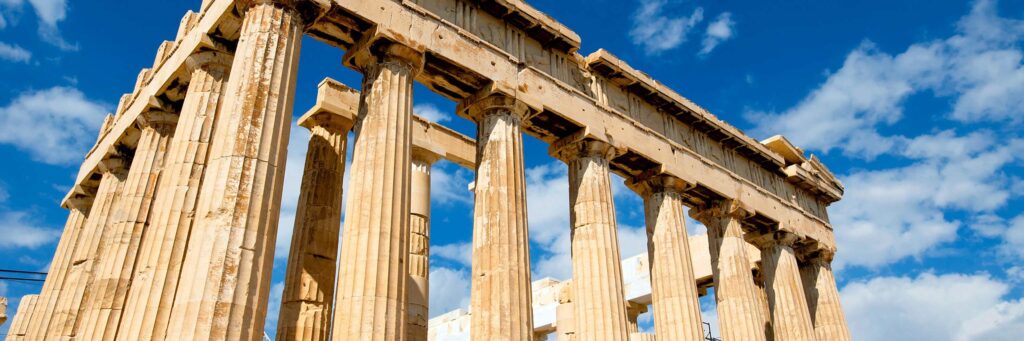
You will take the marvelous journey to the Acropolis, seeing the Parthenon as well as Mars Hill (Acts 17:19) where Paul spoke to the Epicurean and Stoic philosophers. Walk the same paths that Socrates, Plato and Aristotle did centuries earlier. View the world’s oldest dramatic venue, the Theatre of Dionysus, and learn about the way scripture uses imagery from ancient dramas. Climb to the Parthenon and see a building used as a pagan temple, mosque and a church. From Mars Hill, you will view the Ancient Agora (Forum), the Stoa of Attalus and the Temple of Hephaestus.
Plaka
You will have free time for shopping for all your relatives who could not come with you to Greece…
The cost is $2,800 per person, plus airfare, and includes ground transportation, double-occupancy lodging, two meals per day, tour guide fees, and venue admissions. A $200 deposit is required to register. This is an opportunity to see the world of the New Testament firsthand, deepen your understanding of Scripture’s historical setting, and share an unforgettable experience with the Calvary community. Consider joining us in Greece in 2027!
Questions? Contact Dr. Paxton, Director of the Burnham Center for Global Engagement.
"*" indicates required fields